Loading...
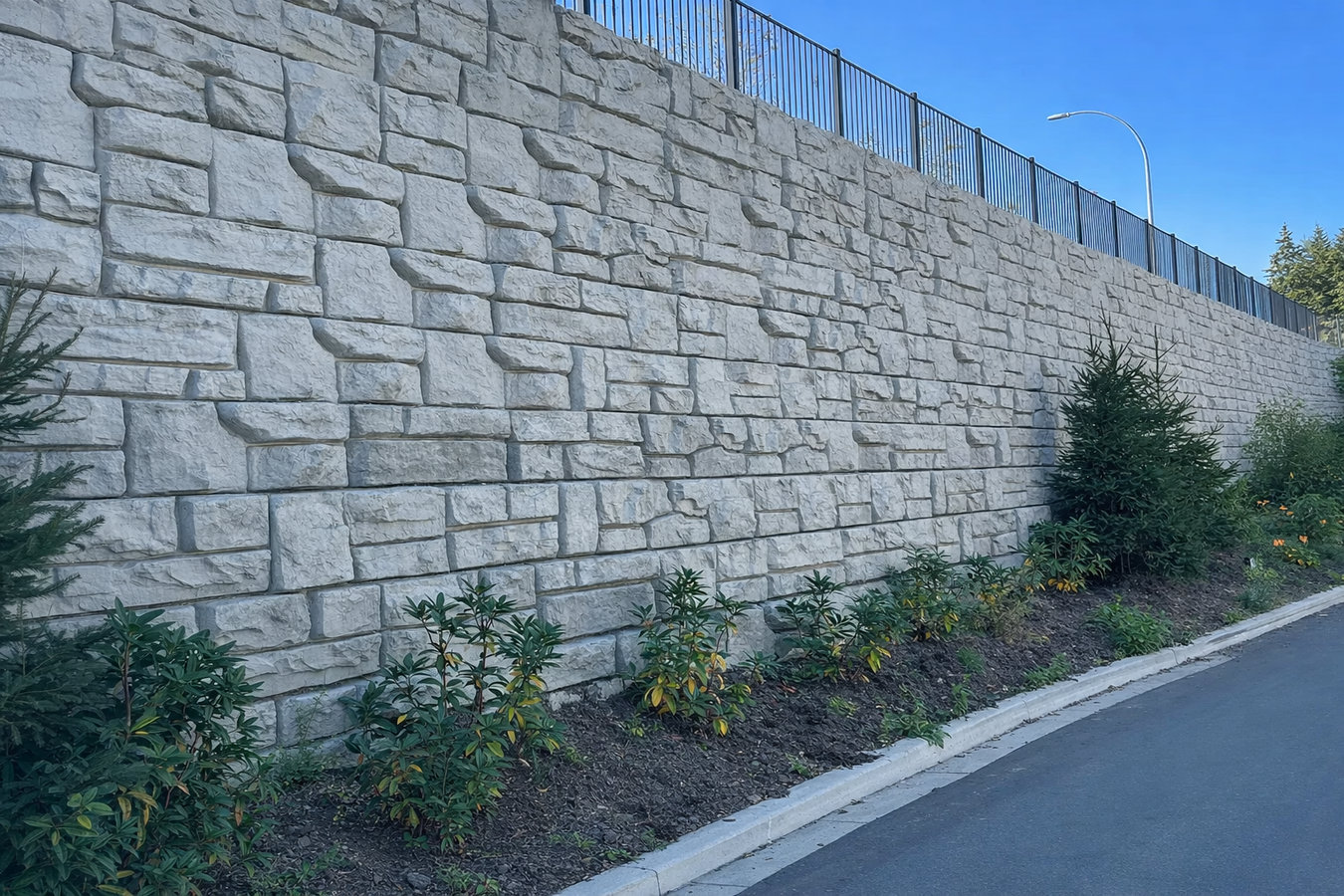
Abilene's clay soil and intense rain events will keep washing your yard away until something holds it back. We build concrete retaining walls that manage water, stop erosion, and protect your foundation.
Concrete retaining walls in Abilene hold back soil on slopes and elevated areas, stopping erosion and managing water runoff - most residential projects take two to five days on-site depending on wall height, length, and drainage complexity.
The most important part of any retaining wall is not the concrete itself - it is what goes behind it. Abilene's clay soil holds water and swells under pressure. Without proper drainage built into the wall from day one, that pressure keeps building until the wall leans, cracks, or falls. A correctly built wall includes gravel backfill and a perforated drain pipe so water has a clear path out regardless of how hard it rains.
If your project involves finishing an adjacent outdoor surface, our concrete floor installation service handles slabs for garages and outbuildings that often sit near retaining structures. Foundation-level walls that need deeper anchoring can also be tied into our concrete footings work.
After a heavy rain, if you see soil, mulch, or gravel collecting at the base of a slope, that is erosion happening in real time. Abilene's intense rain events accelerate this process quickly, and without a wall to hold the ground in place, each storm takes more of your yard with it.
If part of your yard is too steep to mow without risk, too unstable for kids to play on, or constantly losing soil to the lower portion of the property, a retaining wall can level things out. This is common in Abilene neighborhoods built on rolling terrain where lots were not fully graded at construction.
If your current wall - whether old concrete block, railroad ties, or stacked stone - is tilting forward or showing large cracks, it is under more pressure than it was built to handle. Leaning is the most urgent sign. A wall that fails will move far more soil than the gradual erosion you are trying to stop.
When rain hits a sloped yard with Abilene's clay soil, water often runs toward the house. Standing water near your foundation after storms is a warning that soil and water pressure are building against your home's slab. A retaining wall combined with proper grading can redirect that water before it causes foundation damage.
We build poured concrete walls, concrete masonry unit (CMU) block walls, and terraced retaining systems for residential properties across the Abilene area. Poured concrete walls are the strongest option for taller applications and produce a clean, monolithic face. CMU block walls work well for shorter garden and landscape walls where flexibility around irregular terrain is helpful. For steep slopes, a terraced approach using multiple shorter walls reduces the height any single wall must handle and can create usable planting areas between the tiers.
Every wall we build includes drainage as part of the base scope - not an optional add-on. If you are dealing with water pooling near your home's foundation, a properly positioned retaining wall combined with regrading can redirect that runoff before it causes long-term damage. For projects that require deeper structural anchoring, we tie retaining walls into concrete footings to give the wall a stable base even in Abilene's shifting soil. If the adjacent surface needs to be usable afterward, we also handle concrete floor installation so the finished area works as a whole.
Formed and poured on-site for a monolithic, high-strength barrier. Best for taller walls or where a clean, continuous face is important.
Concrete masonry units laid course by course. Flexible for irregular terrain and well-suited for shorter garden or landscape walls.
Multiple shorter walls stepping down a slope instead of one tall wall. Reduces per-wall height, spreads the load, and can create usable planting beds between tiers.
Walls positioned to redirect water and soil pressure away from your home's slab foundation. Addresses active erosion and water pooling near the structure.
Abilene sits on clay-heavy soil that is one of the most demanding substrates in Texas for any below-grade or grade-level concrete work. When it rains, that clay absorbs water and swells. When it dries out - which happens fast in West Texas summers that regularly push past 100 degrees - the soil contracts and pulls away from structures. A retaining wall that was not engineered for that movement will show cracks and lean within a few years. The Portland Cement Association notes that drainage is the leading reason retaining walls fail, and in Abilene's wet-dry climate that risk is especially high.
Many of Abilene's established neighborhoods - including older areas near Dyess Air Force Base and the subdivisions that grew up around the three universities in the 1950s and 1960s - have properties with sloped lots that were never properly stabilized. If your home is in one of those areas, you have likely watched soil inch downhill every spring storm season. A well-built retaining wall stops that cycle. Homeowners in Abilene and the surrounding communities we serve in San Angelo and Brownwood deal with these same soil and climate conditions, and the solutions that work here are built around those realities.
The City of Abilene requires permits for retaining walls above approximately four feet in height, and taller walls may need a structural engineer's review. That process adds a week or two to your timeline, but it also gives you documentation that the work was done to code - something that matters when you sell your home. We handle the permit application for every qualifying project. Learn more about the permit process at the City of Abilene Development Services.
Reach out by phone or the contact form. We respond within 1 business day and schedule a free site visit. A wall quote based on photos alone is rarely accurate - we need to see the slope, soil, and drainage before giving you a number.
If your wall will exceed about four feet, we handle the City of Abilene permit application on your behalf. Permit approval typically adds one to two weeks before the work can begin, so we factor that into your project timeline.
The crew excavates the wall area, prepares a compacted base, and calls 811 before any digging begins. We also excavate behind the wall to make room for the drainage layer - the step that determines whether your wall holds for a decade or five.
Concrete is formed and poured (or block is laid) while gravel and a perforated drain pipe go in behind it. We backfill once drainage is confirmed, then do a walkthrough with you before leaving. Poured walls need several weeks to reach full strength.
Free on-site estimate. We respond within 1 business day and handle permitting for you.
(325) 283-1159We have built retaining walls in Abilene's clay-heavy soil since 2022. Every crew member works here full-time, which means they understand the drainage requirements and temperature swings that affect how walls perform in this specific area.
We pull City of Abilene permits for every qualifying retaining wall project. A permitted wall is on record, which protects you at resale and gives you an independent verification that the construction met local building standards.
Gravel backfill and a perforated drain pipe are included in every wall we build - they are not an add-on. We follow American Concrete Institute guidelines because a wall without proper drainage in Abilene's climate fails faster than almost any other cause.
Every estimate covers wall height, length, drainage approach, permitting, and timeline in writing before we begin. We do not start work on verbal agreements, and no charges appear after the job is done that were not in the quote.
Retaining walls are one of the most site-specific concrete jobs there is - the right answer depends entirely on your slope, your soil, and what is sitting uphill from the wall. That is why every project starts with a free on-site visit, and why we never give phone quotes for this type of work.
Pour a new concrete floor for a garage, workshop, or outbuilding on a stabilized, properly prepared base.
Learn moreDeep footings that anchor structures into stable ground below Abilene's shifting clay soil layer.
Learn moreSpring slots fill fast - the sooner you call, the sooner your yard is protected before the next heavy rain season.